

MeshOS module
AI knowledge retention: experience stays when people leave
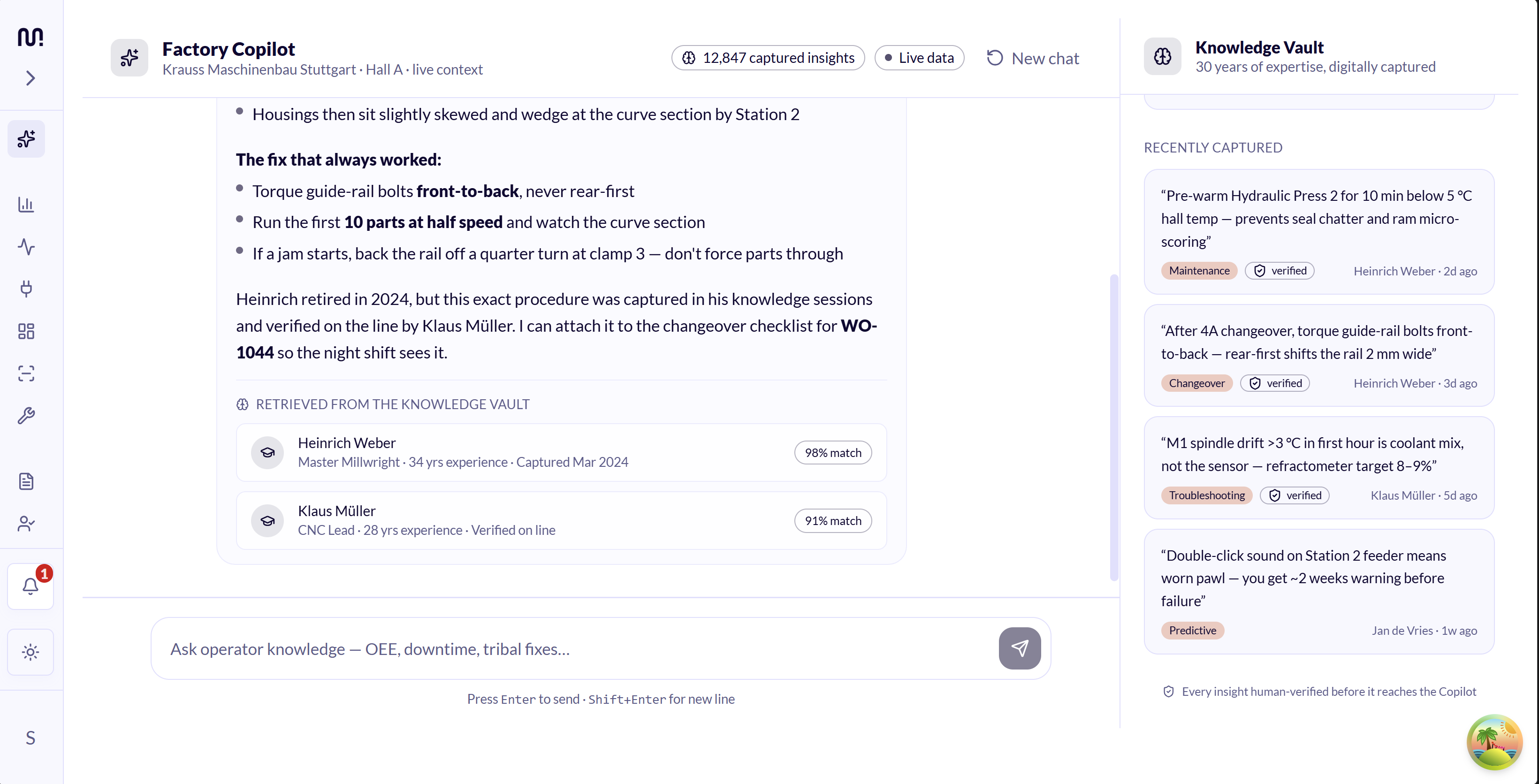
The mechanic who knows every fault on line 3 will retire one day. What he knows sits nowhere you can search: it lives in his head, in loose notes and in ten years of solved breakdowns. AI knowledge retention in MeshOS makes that tribal knowledge searchable: a copilot that draws on your own manuals, logbooks and fault history and answers the way your most experienced colleague would. In every shift, at any hour, even after the person who carried the knowledge is gone.
The knowledge walks out the door, and little comes back in
Nearly a quarter of skilled workers in the Dutch technical workforce are 55 or older, the Dutch ministry of social affairs calculated, and sector association Techniek Nederland expects a need for about 121,000 new technicians by 2029. For the factory floor that is simple arithmetic: experience leaves faster than you can replace it.
In training institute ROVC's TechBarometer, 41% of technical companies say crucial hands-on knowledge sits with colleagues who retire within five years. Losing knowledge is a given. The question is how much of it you keep.
Tribal knowledge
What disappears when an experienced colleague leaves
It is rarely about what the manual says. It is about what thirty years built on top of it: the tribal knowledge, the know-how in your best people's heads, that keeps a factory running.
A large part of what a craftsman knows is known only to that one person. Exactly that part sits in no system, and exactly that part is what you want to capture.
Why the knowledge base stays empty
Almost every company has tried it: a wiki, a documentation project, exit interviews in the final month before the farewell. The outcome is usually the same:
Not because the will is missing, but because documenting comes on top of the real work. Knowledge retention only works when it costs no extra work. That is where the Meshnex approach starts.
- During firefighting, nobody writes anything down.
- Documents go stale faster than anyone updates them.
- Search fails: the answer is in there, but nobody finds it.
- An exit interview does not capture thirty years of pattern recognition in an afternoon.
- Mentoring works, but does not scale: one apprentice per master, only for the questions that happen to come up.
How AI knowledge retention works in MeshOS
MeshOS opens up the sources you already have: manuals, fault history, repair notes, shift handovers. An AI copilot searches them by meaning and builds its answer from what is actually in your own sources.
On the floor it works like this:
So no separate documentation project: the knowledge is captured from data your factory already produces, and the system grows richer with every fault you solve and log.
- Anyone asks questions in plain language: what does alarm 4012 on the filling machine mean?
- The answer comes the way the experienced mechanic would give it: machine, symptom, fix.
- Every answer shows its source, so you can verify before you act.
- If something is not in your sources, the copilot says so honestly instead of guessing.
- New notes and logs are picked up automatically, without separate upkeep.
- The copilot runs where the work happens: on the terminal, tablet or phone at the machine.
Captured from sources that already exist
The copilot does not need a perfectly structured knowledge base. It draws on what your factory has built up over the years:
The copilot searches by meaning, not exact keywords. So a question about 'the film runs crooked' can also find the note from four years ago that says 'web tracking adjusted'.
What it's really about: everyone works with the knowledge of your best people
Knowledge retention is not an archiving project. It changes how the factory runs every day, and the difference is biggest for the people who still have to grow.
That is what knowledge retention is for: a factory that no longer stalls on one person's calendar.
For every role
One copilot, for every role
The same captured knowledge, used differently per role.
Your company knowledge stays yours
Thirty years of fault knowledge is company capital, and it does not belong in someone else's training material. The copilot works for your factory only, on your own sources, in the environment you choose:
That way knowledge retention fits within your own IT and GDPR requirements, including when logbooks and handovers contain personal data.
Honest about AI knowledge retention: what it can't do
A copilot is not a miracle cure. Three limits belong in an honest story, and they shape how we set it up.
And the copilot has to be faster than walking over to that one colleague, or it will not be used. So it lives in the screens already hanging on the floor and answers in seconds.
Start while the knowledge is still there
Knowledge retention has a deadline nobody knows: the day your expert says goodbye. So start small, but start now.
Step 1: we pick one domain
For example the faults of one line or department. Together we take stock of the sources: manuals, logs, notes, history.
Step 2: the sources go into MeshOS
Documents and history are opened up and made searchable. Messy text is no objection: that is exactly where the gain sits.
Step 3: the team asks real questions
The copilot goes live on the floor. Answers show their source, the team checks them, and that feedback sharpens the system.
Step 4: expand and capture
More machines, more sources, more departments. Every question your experts answer along the way goes straight into the knowledge base.
Proof in practice
Knowledge retention in the field
Real projects on real factory floors.
Knowledge capture Thirty years of troubleshooting knowledge, made searchable
An AI copilot trained on years of alarm logs, repair notes and manuals answers troubleshooting questions the way the veteran technician would: machine, symptom, fix. The knowledge stays when the person who carried it retires.
 Recipe digitalisation
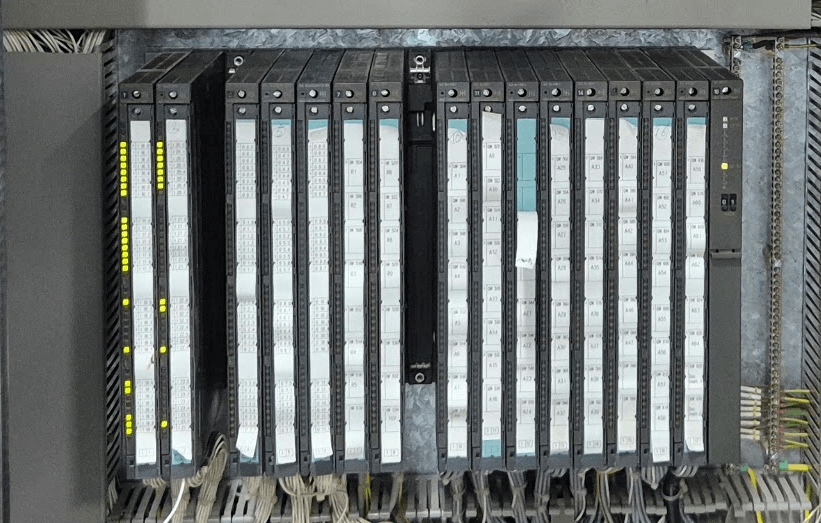
 Recipes from legacy Siemens PLCs, digitally secured
Recipes that only existed on paper and inside ageing Siemens PLCs, now digitally backed up and versioned. Every setpoint change is logged: who, what, when, and what it did to production. Reverting takes one click.
 Predictive maintenance
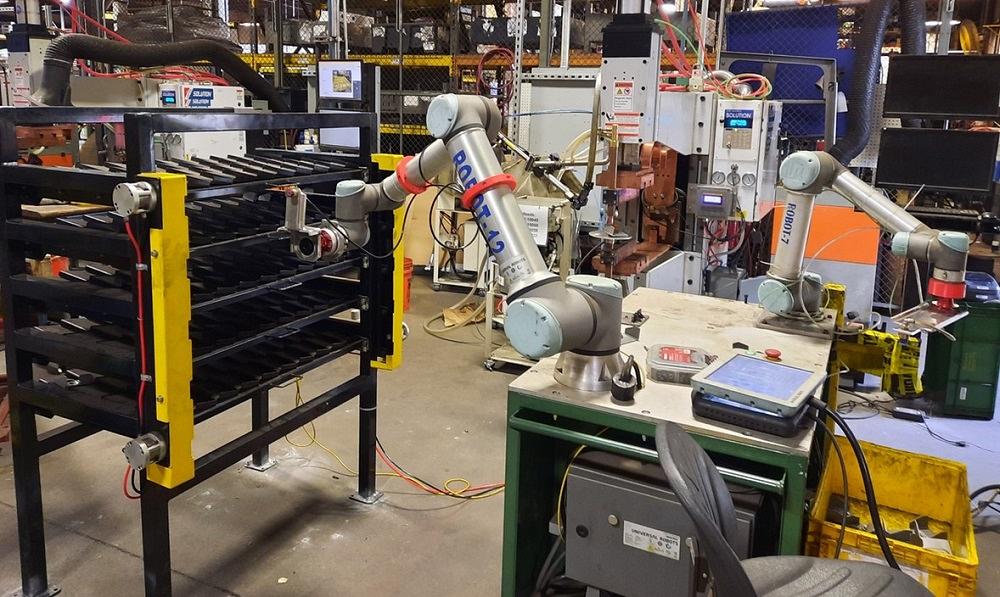
 Failures flagged weeks before the breakdown
Vibration, temperature and current from three critical machines feed an anomaly model that flags deviations weeks before failure. Maintenance planned around production instead of around breakdowns starting with the assets that hurt most, not a full-plant rollout.
Frequently asked questions about AI knowledge retention
What is knowledge retention?
Knowledge retention is capturing the knowledge and experience of employees and making it transferable, so it stays in the company when people leave or retire. In manufacturing it is mostly about hands-on knowledge: fault fixes, settings, workarounds and the experience that is not in any manual.
What is AI knowledge retention?
With AI knowledge retention, an AI assistant makes captured knowledge searchable and directly usable on the shop floor. In MeshOS that is a copilot that draws on your own manuals, logbooks and fault history and answers questions with source references, the way an experienced colleague would.
How do you prevent knowledge loss when experienced employees retire?
By starting before they are gone. First open up what already exists: manuals, fault history, notes and logbooks. On top of that, capture the answers your experts still give out loud every day. After the farewell, part of the knowledge really cannot be brought back.
Does this cost our mechanics and operators extra work?
Barely, and that is deliberate. The knowledge comes first of all from data your factory already produces: logs, notes, handovers, history. No separate documentation project is needed. What we do ask: occasionally checking an answer and filling gaps, and that takes minutes, not afternoons.
What sources can the copilot use?
Manuals and drawings, fault and alarm history, repair notes and work orders, shift handovers and logbooks, procedures and instructions. Machine data that MeshOS already reads counts as context too. Which sources are usable differs per factory; we take stock during the intake.
What if our documentation is messy or incomplete?
Then you are in good company: that is the normal situation. The copilot searches by meaning, so short, messy notes become findable too. Where sources are truly missing, you see it in the questions that stay unanswered: exactly there it pays to capture knowledge after all.
Doesn't the AI make up answers?
That risk exists with every AI, which is why the copilot is built around it: it answers from your own sources, shows where every answer comes from and says so honestly when something is not in your documentation. Checking takes no digging: you click through to the source itself.
Does our company knowledge stay ours?
Yes. Your sources and answers stay in the environment you choose: cloud on European servers, hybrid, or fully self-hosted on your own infrastructure. Your knowledge is not used to train models for anyone else.
Does this work for operators too, or only for maintenance?
For both. Mechanics ask about faults and history, operators about settings, procedures and the reasoning behind them, new colleagues use the copilot as their go-to. The same sources, different questions.
Does the copilot replace onboarding and mentoring?
No. Manual skill and feel for the machine are learned on the floor, from people. The copilot removes the lookup work and the repeat questions, so onboarding goes faster and mentoring is spent on the things that really need attention.
What is tribal knowledge?
Tribal knowledge is the knowledge that lives only in the heads of experienced employees: not written down, not transferable, and gone the moment its carrier leaves. Think of the fault fixes and workarounds that appear in no manual.
How quickly can the copilot go live?
In many cases within about 4 weeks: taking stock of sources, opening them up in MeshOS and going live on one domain. The exact lead time depends on how many sources there are and what shape they are in.
Capture the knowledge while you still can
With every experienced colleague who leaves, answers disappear that you will not get back. Start with one line or one department and see within a few weeks what your factory actually already knows. Tell us which knowledge you don't want to lose.