

Apr 22, 2026
What is an energy management system? Gain control over energy use in your factory
What is an energy management system? Discover how an EMS measures, analyses and optimises energy consumption in manufacturing.
What is an energy management system?
Your energy bill tells you how much energy your factory consumed. But it does not tell you which machine used the most energy, when the highest peak occurred or how much electricity was needed to produce one product. That is where energy management starts.
An energy management system, often abbreviated as EMS, is a system that automatically measures, collects and analyses energy consumption. It continuously monitors energy consumption and connects this data to machines, production lines and other installations. Instead of only looking back at total consumption, you can see where energy is going while production is running and where opportunities for improvement exist.
Within a manufacturing company, an EMS can collect data from energy meters, machines, production lines, solar panels, batteries and charging infrastructure. This information is then brought together in one environment. You no longer only see how much energy the factory consumes. You can also see how much energy is used by a specific machine, production line, shift or production order.
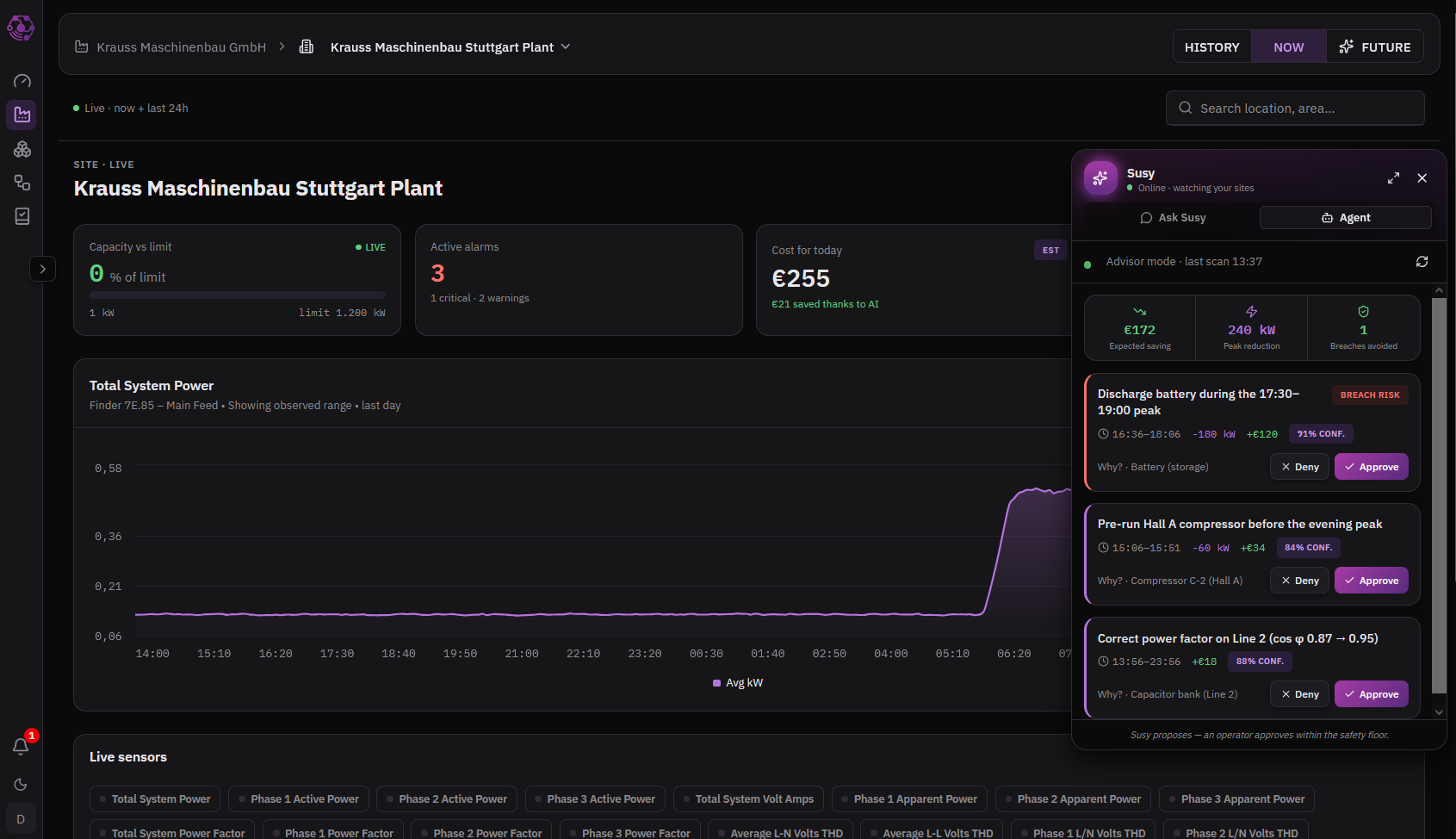
A more advanced EMS can also respond automatically to what is happening. If total energy consumption is approaching a predefined limit, the system can send an alert or redistribute energy demand. The energy management system in MeshOS goes a step further: it forecasts tomorrow's load, plans the battery against day-ahead prices and shaves a live peak the moment the main meter crosses the contract limit.
Energy management therefore moves from reporting what happened afterwards to seeing and controlling what is happening during production.
What is energy management?
Energy management is broader than the software itself. It means continuously measuring how much energy you use, identifying where energy is being wasted and taking action to improve consumption. An energy management system provides the data required to do this.
Without measurements, energy savings quickly become based on assumptions. You know that total consumption is high, but you do not know why. Or you see a peak on the main meter without knowing which machine caused it. An EMS makes that information visible.
How does an energy management system work?
An EMS starts with data. Machines and installations often already generate large amounts of data, but this information frequently remains locked inside a PLC, energy meter or separate software system. An energy management system brings these sources together.
1. Measure energy consumption
The system collects information from existing energy meters, machines and sensors. This can start with the total electricity consumption of a site, but it becomes more valuable when you can zoom in further: by department, production line or individual machine. This creates an increasingly detailed picture of where energy is actually being used.
If certain data is not yet available, industrial IoT solutions can be used to add the required sensors, connectivity and data collection to existing machines and installations.
2. Give energy data context
A value of 40 kWh means very little on its own. It becomes more useful when you know that the consumption came from production line two, during the night shift, while producing a specific batch.
By connecting energy data to production data, you can answer questions such as:
- How much energy do we use per product?
- Which production line consumes relatively more energy?
- When do our largest energy peaks occur?
- How much energy does a machine consume while it is not producing?
- Which production line has the lowest energy consumption per finished product?
Energy consumption then changes from a simple meter reading into useful production information. That is also the principle behind MeshOS: bringing machine data from different sources together, structuring it and making it usable for dashboards, analyses and automation.
3. Detect abnormalities and energy peaks
When energy consumption is measured continuously, patterns become visible. An unexpected peak is easier to identify. But you can also detect a compressor that continues running outside production hours or a machine that gradually starts using more energy.
The EMS can use thresholds and alerts so your team does not have to manually check every graph.
4. Optimise energy consumption
Once you have sufficient insight, you can start making targeted improvements. Energy-intensive processes may be moved to different moments. A large part of your peak demand may be caused by several machines starting at the same time. Or one production line may consistently require more energy per finished product than a comparable line.
You no longer only know that you are using energy. You know where to look for improvements.
5. Automatically control processes
An EMS can go one step further by automating parts of the energy management process. For example:
- Preventing several heavy consumers from starting at the same time.
- Temporarily reducing machine demand during an energy peak.
- Using battery storage when total power demand increases.
- Starting processes when sufficient solar energy is available.
- Sending alerts when energy consumption deviates from the expected pattern.
The system then responds automatically based on predefined conditions.
What can an EMS do for a manufacturing company?
In residential applications, an energy management system often focuses on solar panels, home batteries and electric vehicle charging. The scale is different inside a factory. Dozens of machines, production lines and installations can consume energy at the same time. Energy consumption is also directly connected to production capacity and operational costs.
An industrial energy management system can help you:
- Measure energy consumption per machine, line, shift or product.
- Identify and reduce peak loads.
- Detect unexpected or unnecessary energy consumption.
- Connect energy data to production and machine data.
- Use solar power and battery storage more efficiently.
- Compare energy performance over longer periods.
- Automatically create reports.
The connection between energy data and production data is particularly valuable. Knowing that production line one consumed 500 kWh yesterday is useful. Knowing that energy consumption per finished product was 12% higher than normal gives you a specific issue to investigate.
For many manufacturers, this is part of a broader move towards manufacturing digitalization, where existing machines and data sources are connected and made more useful.
Energy monitoring vs energy management: what is the difference?
Energy monitoring mainly focuses on measuring and visualising. You can see how much energy is being consumed and when it is being used. Energy management goes one step further: the data is used to make decisions or automatically adjust processes.
A dashboard showing that consumption is too high is monitoring. A system that then sends an alert, moves a process to a different time or prevents a predefined power limit from being exceeded is actively managing energy. Monitoring is therefore often the first step towards a complete EMS.
Within the Meshnex solutions, such a project can also start small: for example, by monitoring the energy consumption of one machine or production line before expanding further.
Why is energy management relevant for manufacturing?
Energy costs are part of the production costs for many manufacturers. Yet energy consumption is still often viewed only at site level. At the end of the month, you know how much electricity was consumed, but not necessarily which processes were responsible. That makes improvement difficult.
Imagine two similar production lines manufacturing the same product. Line one consistently uses more energy per product than line two. Without measurements at production-line level, that difference remains hidden inside the total energy bill. An energy management system makes that difference visible and gives you a starting point for further investigation.
Perhaps a machine remains fully powered during downtime. Maybe a compressor is operating inefficiently. Or the heating phase of a process takes longer than necessary. The data does not automatically tell you what the solution is. But it does tell you where to look.
EMS and peak demand
Total energy consumption is not the only important factor. The moment at which that energy is consumed also matters. When several heavy energy consumers operate at the same time, a large power peak can occur.
An EMS can continuously monitor total power demand and indicate when you are approaching a predefined limit. Several actions can then be taken. A non-critical process can start later, battery storage can temporarily supply power or heavy consumers can be distributed more evenly across the day.
The energy management system in MeshOS, for example, plans battery charge and discharge a day ahead and steps in live when the main meter approaches the contract limit. Energy therefore becomes part of production planning instead of only a cost you review afterwards.
Combining energy management with solar power and battery storage
Many manufacturing companies now generate part of their own electricity. But generating your own energy does not automatically mean that it is used at the best possible moment. If solar panels generate a large amount of electricity while production demand is low, that electricity may be exported to the grid or stored. At other moments, electricity needs to be imported from the grid.
An EMS can look at production, renewable generation, battery storage and the electricity grid as one integrated energy system. This allows you to determine where the available energy has the most value at any given moment.
The same principle applies to charging infrastructure, heating systems and other large energy consumers. The more energy flows you connect, the better you can optimise the overall system.
Energy management and ISO 50001
Energy management is not only about live dashboards. For organisations that continuously work on improving their energy performance, reporting also plays an important role. This can include recording consumption, comparing periods and monitoring improvement measures.
Automatically collected energy data makes this easier. Instead of collecting meter readings and spreadsheets once a year, you build a reliable history throughout the year. An EMS therefore becomes useful not only for the technical department, but also for management and reporting.
Do you need new machines for an EMS?
Usually not. Many machines already have PLCs, energy meters or other available data sources. Older installations can be expanded with additional measuring equipment or sensors where necessary.
The first step is therefore not replacing machinery. It is identifying what information is already available. Which energy meters are already installed? What information is available from the PLC? Which machines consume the most energy? And which question do you want to answer first?
That is also the principle behind MeshOS: existing machines stay in place while their available data is made accessible and structured. It follows the same approach as other forms of industrial digitalization: use what is already there and only add what is actually required.
Where do you start with energy management?
Do not start with the entire factory. Start with one clear question. For example:
- How much energy does our main production line use per product?
- Where does our highest power peak occur?
- How much energy do machines consume during downtime?
- Which machines are causing unexpected peaks?
- How much of our own generated electricity do we actually use?
Then connect the required meters and data sources and collect enough reliable information. From there, you can expand: from one machine to an entire production line, from electricity to other energy flows and from monitoring to alerts and automated actions.
This allows an energy management system to grow alongside the questions coming from the factory floor, without requiring a large-scale energy project from day one.
Energy management with Meshnex
Machines, meters and installations often already produce a large part of the data you need. The challenge is getting that information out of separate systems and turning it into something useful. Meshnex helps manufacturers connect energy data to the rest of the production floor.
The energy management system in MeshOS measures energy per machine, line, shift and product, forecasts load, plans the battery and protects the grid contract. Because it runs inside MeshOS, energy sits next to your production and machine data instead of in a separate tool.
You do not need to change the entire factory at once. Start by monitoring the energy consumption of one machine or production line. Make visible where the energy is going and then expand towards peak detection, reporting or active energy management.
Start with the energy problem that costs you the most today.
Frequently asked questions about energy management systems
What is an energy management system?
An energy management system, or EMS, collects and analyses information about energy consumption. It shows where and when energy is being used and can help optimise consumption, peaks and energy flows.
What is the difference between energy management and an EMS?
Energy management is the process of measuring, analysing and improving energy consumption. An EMS is the technical system used to automatically collect and use the required data.
What does an energy management system do in a factory?
An industrial EMS can measure energy consumption per machine or production line, detect peak loads, identify abnormalities and connect energy information to production data.
Can an EMS be connected to existing machines?
In many cases, yes. Data can be collected from existing energy meters, PLCs, sensors and other data sources. Additional meters or sensors can be installed where information is missing.
Do you need to connect the entire factory immediately?
No. You can start with one machine, production line or specific energy question. Once the first data starts delivering value, the system can be expanded step by step.
Conclusion: from energy bill to energy data
An energy bill tells you what you consumed. An energy management system shows you where, when and why that consumption occurred. That difference makes energy data useful on the production floor.
Start small. Measure one machine or production line, add context to the data and identify where energy is being wasted. From there, you can continue building towards a factory where energy is just as measurable as output, downtime and quality.
Meshnex measures, logs and controls energy flows, starting from the machines and meters you already have. Take a look at the energy management system in MeshOS, read how MeshOS connects energy data to your production data or contact us to discuss which energy question you want answered first.